Feedback needed a next step.
More targeted guidance, resources and opportunities for practice.

 VS Code
 Python
 Streamlit
 GPT-4
 SQLite
 Pandas
 Google Forms
 Excel
 PowerPoint
Researching, developing and evaluating an AI-powered assessment feedback system.
How can AI make assessment feedback more useful without removing educators' control?
I investigated an existing system, translated research findings into four technical enhancements, and evaluated the resulting application with 74 students and educators.
Research-led development
Six stages, connecting the original research to the features I developed and the results I measured.
Understanding the problem
I analysed previous research and evaluations of the Original Feedback System (OFS), identifying four areas for improvement.
More targeted guidance, resources and opportunities for practice.
Key information was fragmented across multiple pages.
Educators needed to review, edit and track feedback.
Feedback could be generic, inconsistent or unsupported.
Evidence base: literature review, Jones (2023) and Carver's educator workshop (2024).
Before development
I evaluated the original system with 3 students and 3 educators, using their feedback to validate and refine the development requirements.
The purpose was to inform the redesign, not to measure its final success.
Problems to priorities
Each requirement became a specific area of technical development. Select one to see exactly what I built.
ER1–ER3 drew on prior research and my preliminary evaluation. ER4 was informed by literature and earlier evaluations.
ER1 / From research to implementation
Students needed more than a summary of their performance.
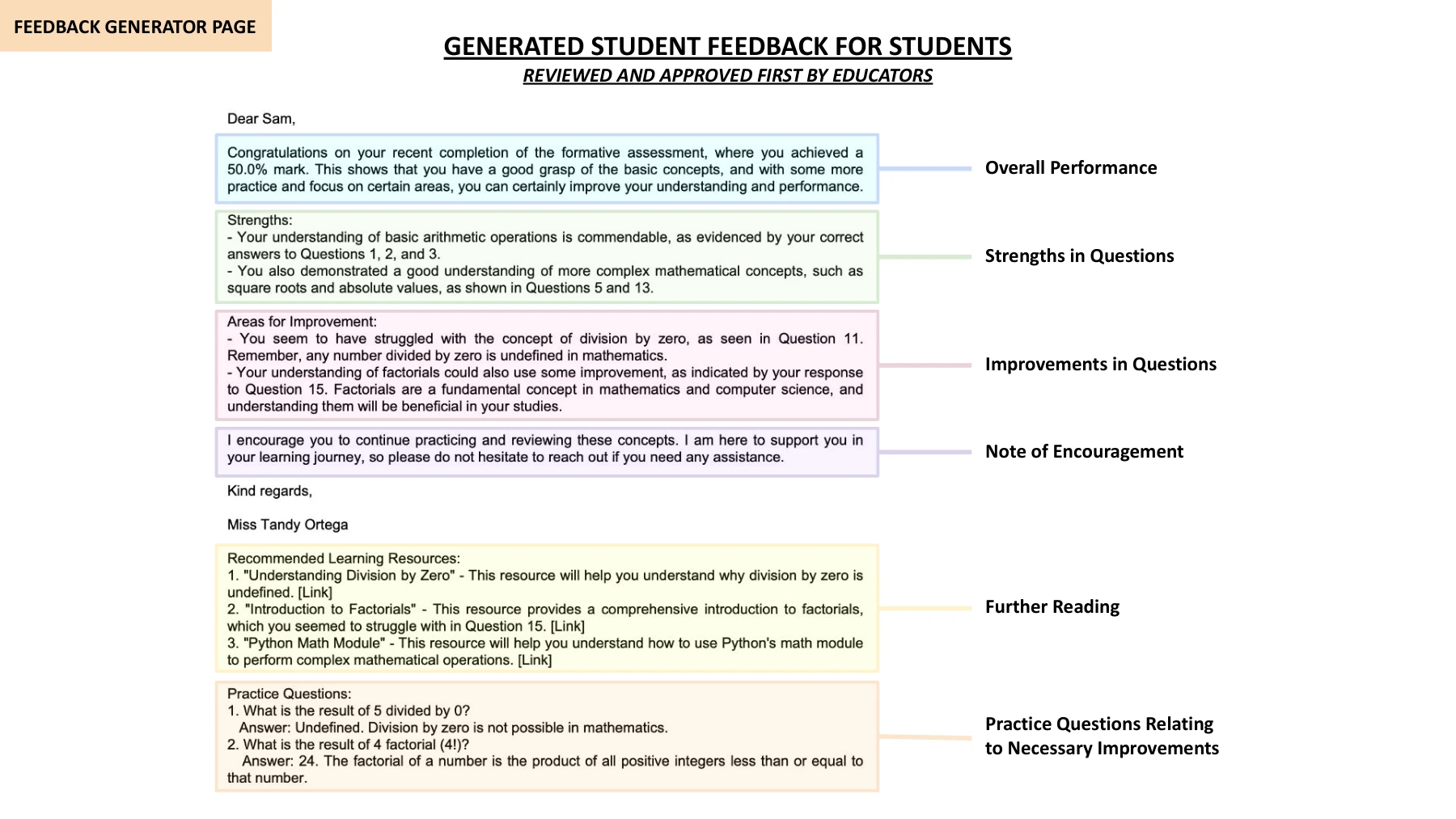
The build_prompt() function
assembled assessment-specific instructions.
Boolean controls determined whether
further reading and practice questions
were requested.
build_prompt()

include_further_reading

include_practice_questions
Function and control names from the implementation, not a complete source-code excerpt.
ER2 / From research to implementation
Educators had to navigate scattered information to identify learning needs.
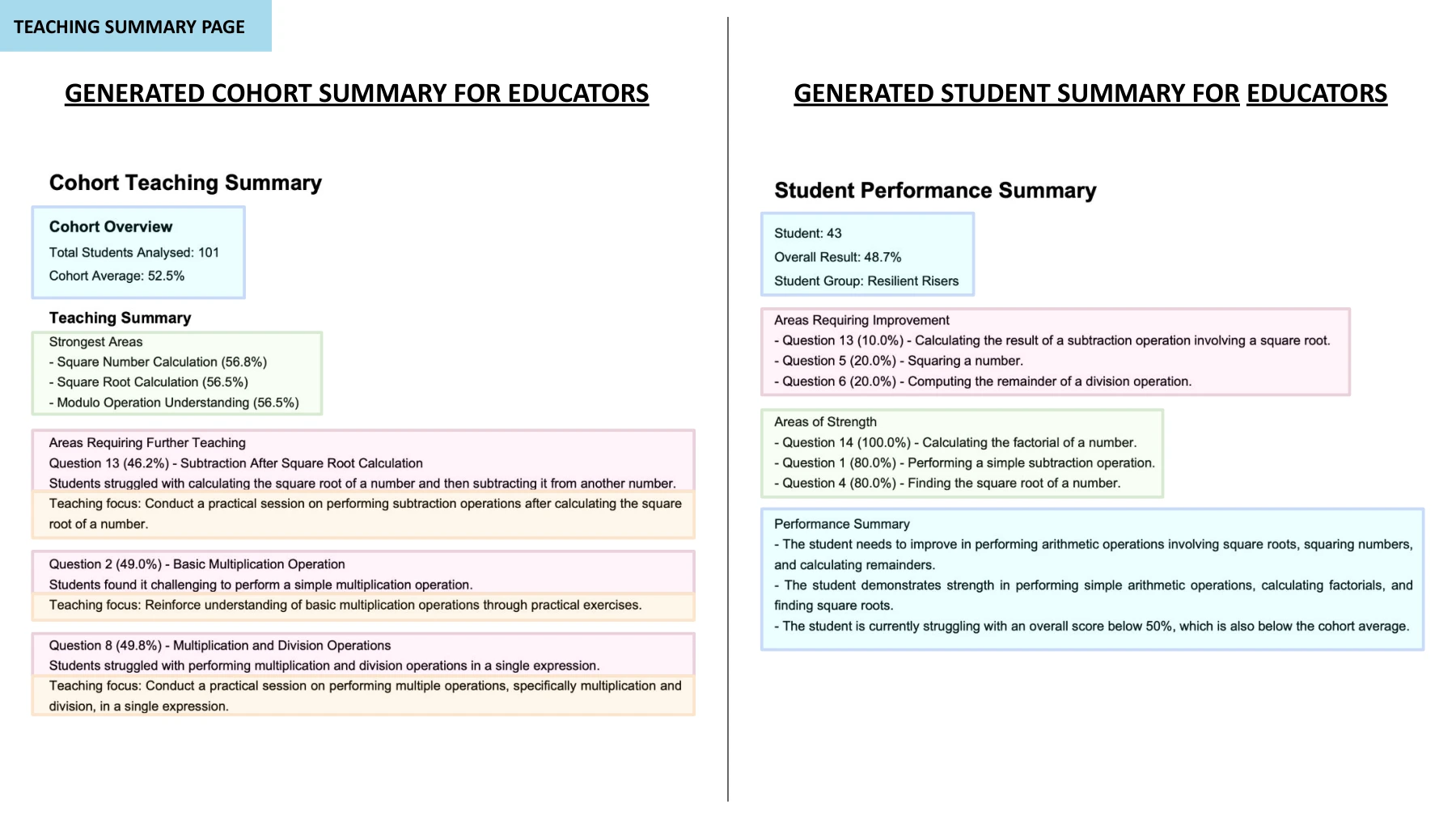
I used Pandas to filter shared student performance data, Streamlit controls to update views, and NumPy percentiles to create cohort-relative performance groups.
student_summary

st.radio()
st.selectbox()

np.percentile()
Key data structures and API functions used in the development.
ER3 / From research to implementation
AI-generated feedback needed human review, editability and traceability.
Critical safeguard: Editing or regenerating feedback invalidates outdated moderation and export states.
SQLite preserved both the original generated feedback and educator-managed content, while tracking editing, moderation and export separately.
original_feedback
feedback_text

is_edited
is_moderated
exported
Composite identifier: assessment name + exam type + student ID.
ER4 / From research to implementation
Generated feedback could vary in structure, detail and evidential support.
I centralised group-specific instructions and reused common generation logic, rather than relying on unrelated prompts.
get_group_instruction()
        ↓
    build_prompt()
        ↓
 structured GPT-4
      feedback
Simplified architectural sequence based on the implementation.
After development
I used criterion-based purposive sampling and evaluated the enhanced system with students and educators from HE and FE settings.
Evaluation design
Focus groups / interviews + questionnaire
Standardised demonstration + questionnaire
A measurable result
The final evaluation found positive perceptions of the enhanced system, while highlighting areas requiring further refinement.
60 of 74 participants reported satisfaction with the Enhanced Feedback System.
Final mixed-methods evaluationThe strongest findings
Participants valued structured feedback; students particularly appreciated actionable guidance.
Educators valued the Teaching Summary, editable feedback and moderation tracking.
Trust depended on verification, appropriate context and educator oversight.
Future work should strengthen assessment context, verification and evaluation in live teaching settings.
Results reflect perceived effectiveness. The study did not establish improvements in learning outcomes, real-world time savings or institutional adoption.
The working product
Explore the full application or jump to a specific feature.
Explore further
Full presentations covering the research methodology, implementation decisions, technical architecture and results.